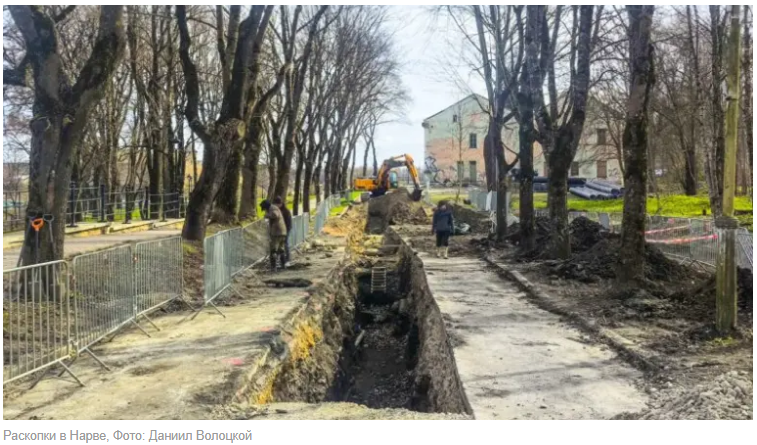
In Narva’s Pimeaia Street, researchers have stumbled upon a true “nexus of time”—a site where multiple eras converge. Beneath the surface lies more than just fragments of the past; it is a historical drama unfolding, from the mysterious Dark Gates to the charred remains of a catastrophic fire and 16th-century military innovations.
The Phenomenon of the Dark Gates: A Maze of Disorientation
The Dark Gates stand as one of Old Narva’s most enigmatic structures. Their early iterations featured a narrow, winding passage with a sharp turn that caused travelers to lose their bearings: the entrance was visible, yet the exit remained hidden. According to the local publication gazeta.ee, this disorienting effect is precisely what gave the gates their name.
Today, archaeologists are effectively restoring this lost landmark to the city map. Researcher Ilya Davydov notes that the foundations currently uncovered belong to the fourth and final version of the gates, built in 1849 and dismantled in 1875. However, the site itself has been in use since at least the 15th century.
16th-Century Military Tech: Ancient “Modular Fortifications”
One of the most unexpected finds is a series of massive wooden structures dating back to the Livonian War. These take the form of enormous log crates filled with stone and earth.
In essence, these are the 16th-century equivalents of modern modular block-containers used to assemble defensive lines. These structures provide a rare glimpse into how the city's defenses were constructed under the constant threat of siege.
Inside, archaeologists discovered ceramics characteristic of North-Western centers such as Pskov, Novgorod, and Ivangorod, serving as direct evidence of the region's deep cultural and commercial ties.
Echoes of the Great Fire: The Layered Pavements of Old Narva
Another layer of history is revealed through the city's infrastructure. Archaeologists found a wooden pavement laid in two distinct phases. The lower layer decayed over time, and a new one was constructed directly on top of it.
Excavation data suggests that the upper layer was destroyed in the Great Fire of 1659—a catastrophe that virtually wiped the wooden city of Narva off the map. To this day, burn marks are visible in the wood's structure, standing as a silent witness to the tragedy.
Regional Cultural Code: Pskov Ceramics and Silver Coins
Beyond the heavy structures, scientists have unearthed more "personal" artifacts, including silver coins from the 1590s. These help pinpoint the exact moment this area transitioned from a purely defensive zone into a hub of urban life.
The North-Western style ceramics complete the picture: Narva was never an isolated outpost, but rather a vital link in a broad network of regional contacts.
The “Nexus of Time”: The Future of the Dark Garden Excavations
The excavations in the Dark Garden (Pimeaid) are ongoing, and every new layer promises further discoveries. The site is already being hailed as a key to understanding the history of Old Narva, where several centuries of life are literally stacked one on top of the other.
Which other vanished landmarks of Narva would you like to see rediscovered or restored?
Comments
0Add a comment