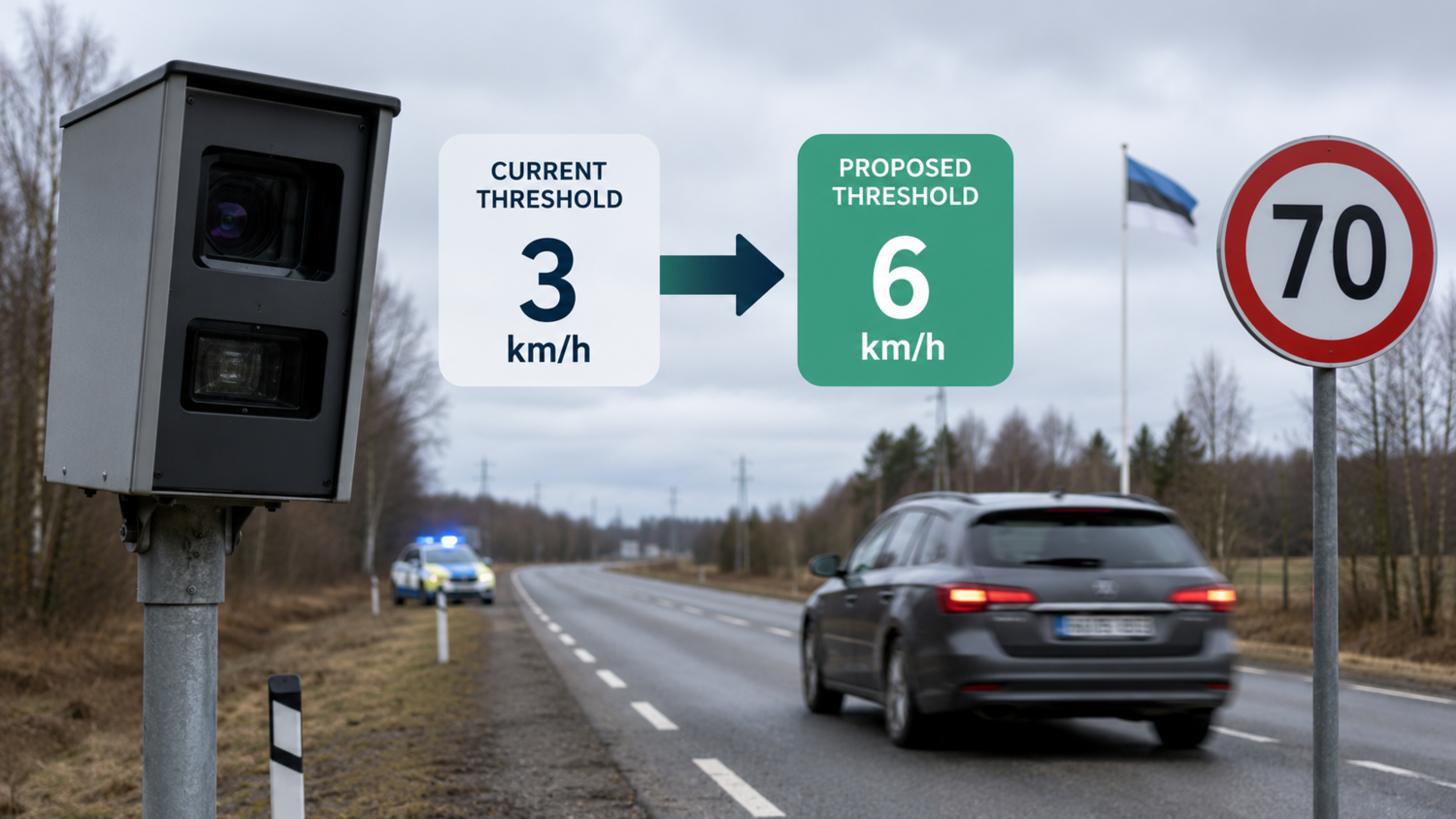
Estonian police are considering raising the speeding fine threshold from the current 3 km/h to 6 km/h. If the change is approved, speed cameras would no longer automatically issue fines for the smallest speed violations.
This would not change the legal speed limit. Speeding would still remain an offence. The possible change concerns only the threshold at which a camera-recorded violation leads to a fine.
According to the Police and Border Guard Board, around half of speeding offenders exceed the permitted limit by only 2–3 km/h. PPA Deputy Director General Kristi Mäe said that under the new approach, such drivers would no longer receive fines.
Police say the proposal is intended to shift attention to more serious speeding violations. According to the agency, a significant share of resources is currently spent processing minimal excess-speed cases.
“For us, this means we would be able to focus on drivers who exceed the speed limit more significantly. Our goal is to ensure road safety, and fines should be issued to those who exceed the limit more noticeably,” Kristi Mäe said on ERR.
The initiative is still under analysis. According to the police, it would not require a change in law: an internal decision by the agency would be enough.
The issue emerged amid a wider debate over mobile speed cameras. On June 17, the Riigikogu adopted amendments to the Traffic Act requiring drivers to be warned about automatic speed measurement.
Under the adopted amendments, outside built-up areas, a warning sign must be placed 300–500 metres before the measurement point. In built-up areas, the sign must be placed 150–300 metres before the camera.
PPA opposed mandatory warning signs before mobile speed cameras. Police argue that such signs cause some drivers to slow down only before the camera and then accelerate again.
Taavi Kirss, head of the PPA traffic supervision department, had earlier proposed raising the fine threshold from 3 to 6 km/h instead of introducing mandatory signs. According to him, this would show more trust in drivers and reduce the number of fines for accidental minor speeding.
MP Valdo Randpere, one of the initiators of the law on warning signs, called the police proposal reasonable. He said that if the 3–6 km/h range really accounts for about half of all fines, the current practice needs to be reviewed.
Road safety experts warn that such a decision must be clearly explained to drivers. TalTech professor of transport planning Dago Antov noted that speeding remains one of Estonia’s main road safety problems, especially outside cities.
At present, a warning fine for speeding recorded by a camera is calculated using the formula of 7 euros for every kilometre per hour above the limit. The maximum warning fine is 300 euros.





Comments
0Add a comment